
Does Closing Vents in Unused Rooms Help?
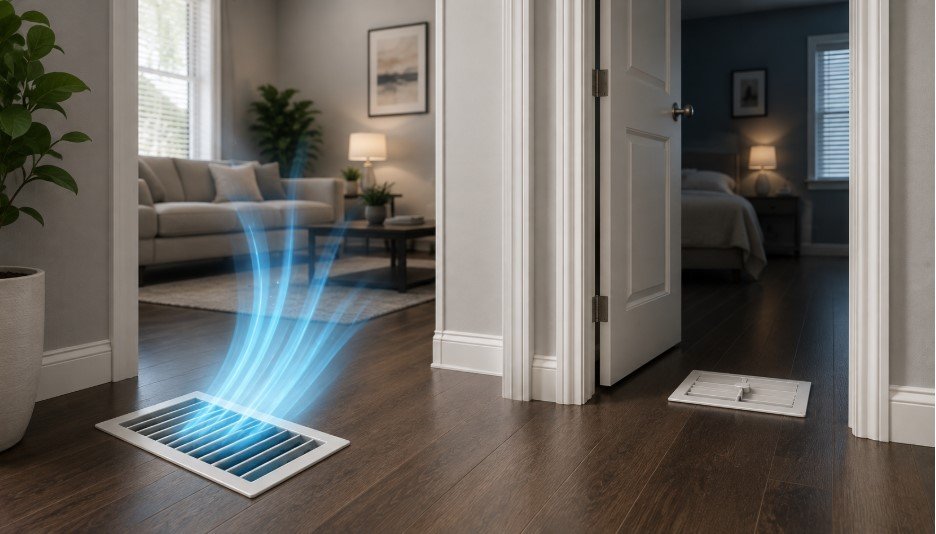
You cool the whole house but you only live in half of it.
So you walk around and shut the vents in the spare room, the guest room, and the basement.
It feels like free money.
It is not.
Here is what actually happens once those vents close.
The short answer
Closing one vent in a big house will not cause much harm.
Closing three or four will.
Your system was sized and installed with every vent open. That is the only way the numbers work.
Take away that space and the air has nowhere to go.
Your ducts are not a garden hose
People picture a hose. Cover part of the end and the water shoots out faster.
Air does not behave that way inside sheet metal.
When you close a vent, that air does not disappear. It pushes back into the duct.
Pressure builds up. In the trade we call it static pressure.
Higher pressure means the blower moves less air through your whole house, not just the room you closed.
The blower does not slow down, so the bill does not drop
Most systems in Lodi and around Bergen County still use a fixed speed blower motor.
That motor spins at the same speed no matter how much pressure it is fighting.
Some of them actually pull more power as the pressure climbs.
So the fan works harder, delivers less cold air, and runs longer to reach the same temperature.
The savings you pictured never show up on the bill.
Extra pressure finds every leak in your ductwork
Older North Jersey homes usually run ducts through an attic, a crawl space, or an unfinished basement.
Almost all of them leak somewhere at the seams and joints.
Raise the pressure inside those ducts and more cold air blows out into places nobody lives in.
You closed a vent to stop wasting air and ended up losing more of it.
Low airflow can freeze your indoor coil
Warm room air passing over the indoor coil is what keeps it from icing over.
Cut that airflow and the coil gets too cold.
Moisture on the coil turns to frost, then to a block of ice.
Now the system blows warm air, water drips where it should not, and the compressor works under strain it was never built for.
A frozen coil in July is one of the most common calls we get, and closed vents are often part of the story.
Closed rooms get damp, and New Jersey summers make it worse
A room with no airflow does not just sit there quietly.
It gets warm. It gets humid. Then that humid air drifts toward the cooler rooms.
Dew points here in July and August sit high enough that a closed room can smell musty within a couple of weeks.
Closet walls, ceiling corners, and anything stored in that room take the hit first.
Closing vents in the basement in summer
This is the question we get most, so it deserves its own answer.
The basement is already the coolest part of the house.
Cold air sinks, so a good share of your cooling settles down there whether you want it to or not.
Of all the rooms in the house, the basement is the most reasonable place to hold back some air.
But it is also the dampest part of a New Jersey home in summer.
Air moving through a space is part of what keeps moisture in check.
So close basement supply vents part of the way, not all the way.
Leave the return path open so air can still circulate.
If the humidity down there sits above 60 percent, run a dehumidifier instead of shutting off the air.
A finished basement you actually use should keep its vents open.
What about closing AC vents in unused rooms just partway
Partway is far safer than all the way.
A simple rule of thumb keeps you out of trouble.
Keep at least eighty percent of your supply vents fully open.
Never close the vent in the room that holds your thermostat.
Never close a vent in a room with the return air grille.
And check that furniture, rugs, and curtains are not blocking the vents you meant to leave open, because that does the same damage without you knowing.
When closing a vent is actually fine
A single vent in a home that has ten or more of them.
A room that runs colder than the rest of the house all summer.
A finished room over a garage that overcools while the rest of the house is still warm.
A storage room with the door left open so air can still move through.
Outside of cases like these, leaving vents alone is the safer bet.
What actually cuts the bill instead
Balance the system properly
Most duct runs have dampers near the main trunk. A technician can adjust those to send more air where you need it without choking the system.
Seal and insulate the ductwork
Sealing the joints and wrapping ducts in unconditioned space usually saves more than any vent you could close.
Add zoning
A zoning system uses motorized dampers and a bypass so the equipment stays happy while different floors get different amounts of air.
Put in a ductless mini split
If you only use a few rooms, a mini split lets you cool those rooms directly and leave the main system off more often.
Fix the return air
Plenty of homes have enough supply and not enough return. Adding a return often solves the hot room you were trying to fix by closing vents somewhere else.
Change the filter and check the attic
A clogged filter creates the same pressure problem as closed vents. Thin attic insulation makes the whole system fight harder all summer.